
The island of Ireland weighs heavily under the weight of patriarchal worldbuilding, and yet still has an abundance of feminist activism and practice. But the necessary story of defiance against domination often, and for very obvious reasons, overshadows another tale that situates this and other feminist practices as forming part of the island’s legal worldbuilding. In a new article in the Dublin University Law Journal called ‘Hy-Brasil Law School: A feminist law school for the island of Ireland’ I use these tales to imagine a feminist law school for the island.
 I placed the Law School on the mythical island of Hy-Brasil. On Hy-Brasil I undertake feminist worldbuilding, using the many innovative and imaginative feminist actions of the past and present across the island to make the claim that the rich feminist legal praxis invites us to explore new ways of doing law and undertaking legal education that we should embrace.
The article uses backcasting as its primary method that, in turn includes other feminist methods such as pre-figuration, critical utopian worldbuilding, and (anti)hagiographies to create a new (feminist) Irish legal canon. This is an avowedly feminist way of writing; there are no claims to objectivity or rationality, because first I believe that rigour requires us to admit to the subjectivities involved in what is chosen, but also because it is my account. Hence the appearance of The Den kids’ show and Mary Robinson’s election as President as central to my own story. Using the idea of Ursula K. Le Guin’s Carrier Bag Theory of Fiction–Hy-Brasil Law School is very much my creation, but I invite others to create their own and to challenge my choices.
In the piece I was inspired by the words of artist Stephen Dunne, ‘not as It Was [Is] But as It Might [Can Be] Have Been’ as a prompt to start the process of backcasting that contains a feminist legal present containing the past, present and future. I also thought more clearly about ‘islandness’ and what it means including how it impacts on our colonial history and our inability to see the Brehon law – in form and, sometimes, in content, as a form on Indigenous Law to consider rather than to be embarrassed by.
Backcasting comes from energy policy analysis and is a practice of describing a desired present/future – for me a feminist law school – and working backwards in time to consider what stages/forms/policies/values/laws were possible that could produce that outcome. Backcasting aims for real-world implications. Backcasting does not generate a single outcome; there are so many variables and combinations, particularly if you do not seek to universalise or homogenise. But what it does do is enable the other possibilities of legal worldbuilding to be present, which were plausible paths that could have been taken, which disrupts the inevitability of our legal present. Backcasting demands that we think about the patterns of choices and the outcomes they produce. Backcasting creates a mirror universe – have a look at Star Trek if you want to see the fun that can be had with those – and offers a critique of what appears settled, and renders it all contestable.
Within backcasting I use feminist legal prefiguration and specifically Domhnall Ó Colmáin’s Párliament na mBan, Anna Doyle Wheeler’s 1830 manifesto The Rights of Women, Eva Gore-Booth’s The Women’s Suffrage Movement, the 1971 Irish Women’s Liberation Movement’s Manifesto Chains or Change, and Clár na mBan’s submission to the Forum for Peace and Reconciliation to make what might/can be into the present. Párliament na mBan, written around 1670 is a revelation, and with Maebh Harding and Julie Morrissey, we have some exciting plans to bring that to life in the coming months. The article uses two utopias – one fictional and one political Amelia Garland Mears’ Mercia, the Astronomer Royal and The Appeal of One Half of the Human Race, Women, Against the Pretensions of the Other Half, Men by William Thompson and Anna Doyle Wheeler to see how Irish feminists have been undertaking utopian worldbuilding in ways that mirror the patriarchal utopias we now inhabit. The article also uses (anti)hagiographies and, in particular, the life of Nell McCafferty – as an example of how we go about finding other canonical lawmakers. There are absences. Sometimes due to space, some because I chose to prioritise some content, or to choose documents which I identify with, others because the methods I used did not identify them. But this leaves amble space for others to come and join in this conversation.
But why Hy-Brasil? This too is in some ways a personal choice. It is sometimes said to be located on the coast of the Beara Peninsula, the place in which I am always happy. But also, because it appeared on maps as a real place for hundreds of years, it is both there and not there. Also, because law happens in a place, and legal education on the island did not always take place in our urban centres.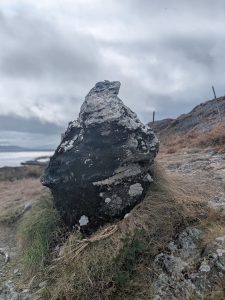
Since I wrote the piece, I was fortunate enough to be able to spend a day with other feminists considering creative methods. One session, led by Charlotte Mills, made me think about how I might represent my research through art. And I’ve been thinking, how would I do that with Hy-Brasil? I’ve settled on a logo for the School, and I’ve chosen An Chailleach Bhéarra/The Hag of Beara. She created our landscape and changes and adapts with the seasons. But she was also said to be the goddess of sovereignty, giving kings their right to rule their lands. A powerful figure in the construction of the state.
Hy-Brasil Law School is not farfetched, implausible, or naïve. The island of Ireland/Hy-Brasil embodies feminist jurisdictional innovation that is distinctly Irish, but also contributes to global conversations about legal feminism. Hy-Brasil – or more importantly what it represents – should move to overshadow the island’s other legal legacies. We have an incredibly rich feminist legal praxis – we need to shout about that.
Aoife O’Donoghue is a Professor of Law at Queen’s University Belfast
Discover more from Doing Feminist Legal Work
Subscribe to get the latest posts sent to your email.