
Funded by Northern Bridge and Gender and Law at Durham, in June 2024 we ran a workshop titled Feminist Utopias and Constitutionalism: Reimagining Feminist Futures. The purpose of this workshop was to provide hands-on training in critical feminist methodologies of knowledge production. Using the popular 2023 Barbie film as a starting point, the event was directed towards engaging with what makes a feminist utopia: specifically inviting imaginings beyond – and against – the liberal feminist framework of the film.
In running the workshop, we were driven to infuse feminist methods into not just the content – but the form of the gathering. Oriented towards the discipline of law (but open to intersecting participants) we wanted to tackle how existing engagements with feminist methodologies within the legal field tend to remain abstract, theoretical, and thematically focused. Against this grain, our aim was to draw on the rich tradition of feminist activism to create the space where we can radically imagine alternative feminist futures together.
We opened our workshop with an evening social event, the night before the full-day workshop. At this social event, participants were invited to use provided second-hand Barbies to imagine, and act out together, how they wish academic gatherings would unfold. As expressed to the participants, this social activity set the tone for the imagination and wonder we hoped to embody throughout the workshop.
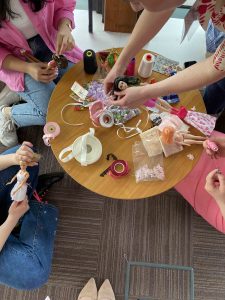
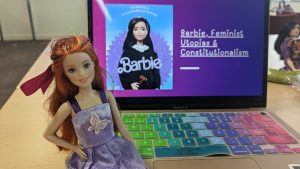
The full-day workshop on the following day opened with presentations from invited panel members providing feminist reflections on the Barbie movie.
Drawing on their own research on the role of feminist manifestos in constitution-making, Dr. Ruth Houghton and Prof. Aoife O’Donoghue outlined the method of manifesto writing as a precursor to constitutional change. Next, Dr Katucha Bento set out a critique of the feminism of Barbie, confronting the intersection of mainstream feminism with race, gender and political activism. Dr Ope Adegbulu then delved into a decolonial critique of the fashion in Barbie, using this as a vehicle to draw attention to the oversimplification of the film’s narrative and its avoidance of deeper structural inequalities. Participants then worked together to craft their own manifestos before reflecting on how to move from this manifesto to the writing of a constitution. Through this process they were encouraged to question the political and legal constraints of constitution drafting in modern society, the role of legal text, and legal language in this process in order to radically imagine what could otherwise be. Then, facilitated by Ms Twemlow, these reflections were consolidated into collective manifestos and constitutions for inclusion in a workshop zine. The Barbies from the social event were utilised to enact a ceremonious passing of these documents.
In this post, we explore both the themes drawn out by Houghton, O’Donoghue, Bento and Adegbulu and the feminist methodological orientations which informed the workshop.
The point of the feminist manifesto
The manifesto is a method of ‘articulat[ing] harms and claim[ing] political spaces’[1] with a very long history. Closely related to constituent power,[2] the French Declaration of the Rights of Man and the Citizen (1789) is an early, though overlooked example.[3] But in its long history, the manifesto is seldom explored as constitutionalising tool, a foundational moment in the emergence of a new constitutional order in place of an old one. Consequently, the space occupied by a feminist manifesto as a counter to the manifesto is left largely unexplored. This ignores the deconstructive power of feminism in a constitutional space: to lay bare the patriarchal, exclusivist undergirding of that space and demand its antithesis.
The use of Barbie as a lens through which to look at the potential of the feminist manifesto is particularly apt. Ruth Houghton, Colin Murray and Aoife O’Donoghue analyse BarbieLand as ‘simultaneously the dream and nightmare of “classical liberal” nineteenth-century advocates of a limited franchise’, where, beneath a superficial veneer of meritocratic leadership lies a familiarly liberal (and equally rancid) underbelly: inequalities based on property, low participation by the inhabitants of BarbieLand in its governance and a rigidly structured society where unconventionality is othered and cast out.[4]
The draw in Barbie – according to Houghton, Murray and O’Donoghue – is the explicitly gendered reversal of this familiar classic liberalism. Barbie is a satirical exposé: the elite Barbies are women, but their society is simply a tyranny with women on top. This allows for an exploration of how the real world tyrannises women generally, and how women, no matter their claim to authority, are seen as a destabilising force. But if BarbieLand is a tyranny, the failure of the Kens’ coup at the end of the film reveals a fundamental truth: ‘[t]o be legitimate tyrannicide must not merely replace tyranny with a new iteration.’[5]
The workshop participants were then invited to consider that Barbie as a film reveals a deeper truth: the structured tyranny of BarbieLand does not in fact benefit any of its residents – including the Barbies, because the structures and their ultimate control rest with the toymaker Mattel, responsible for creating the entire world around which the Barbies and Kens experience their existences. It is in Mattel that we find the impetus for the thin veneer of ‘matriarchal’ meritocracy which conceals a dark underbelly: a capitalist venture that purports to celebrate feminism has no women on its board, and when existential crises threaten to upend the order of BarbieLand, Mattel literally demands that Stereotypical Barbie return to her box, and metaphorically to the very order which generated the crises in the first place. Fundamentally, we begin to realise that all of the shortcomings with the feminist vision of BarbieLand: its lip-service to diversity, its white, Western liberalism, its hollow meritocracy and its disenfranchisement and dispossession of the Kens (for whom there is no Dream House) serve the capitalist interests of the true tyrant – Mattel.[6]
It is at this point – the end of the film – that the workshop participants begin to understand that we need something fundamentally different – even antithetical to the existing (and exhausting) strictures – rather than replicate them with a different elite. We therefore turn to the power and capacity of feminism to highlight iniquity and refashion spaces around inclusivity. It is here that we craft a new constitutionalising space. But first, we must understand and navigate feminism.
Introspections within feminism(s)
“Thanks to Barbie, all problems of feminism have been solved”.[7]
Although this statement by the narrator in the opening of Barbie is meant as a satirical trope to provoke reactions from the audience, it also symbolises a type of Western, neoliberal, white ‘mainstream feminism’.[8] Mainstream feminism is individualistic in essence and it fails to acknowledge the complexity of heteropatriarchy and its entanglements with colonialism and racial capitalism, where one cannot be dismantled if the other survives.[9]
This limited and narrow interpretation of feminism, that is far from emancipatory for the 99%,[10] is embodied in BarbieLand, a pink and plastic world where Barbies – women– are ‘empowered’ and free to do and be whatever they wish. In BarbieLand, the representation of diverse identities is often superficial or tokenistic, reducing complex lived experiences to mere aesthetic choices. The absence of narratives that address systemic oppression, intersectionality,[11]and the specific struggles of marginalised groups means that BarbieLand’s version of feminism continues to uphold a narrow, hegemonic, and exclusionary vision of womanhood.
Within this limited narrative, there is no scope for addressing other issues that are central to feminism, such as exploitation of labour, care work, environmental and climate justice, reproductive justice, or disability rights. This myopic view was particularly problematic considering the aim of the workshop, which involved conceptualising and writing feminist manifestos for constitutional change. It became evident that within the world of Barbie, the experiences of oppression and resistance of women colour, trans women, queer women, migrant women, or disable women were flattened or extinguished. In such a context, imagining and practising an inclusive feminist future becomes rather elusive.
Criticisms of this version of feminism are not new. An abundance of literature produced by Black, Third World, Decolonial, and Queer feminist scholars warn about the dangers of falling into the trap of mainstream feminism as an essential Western neoliberal project.[12] When we decided to use Greta Gerwig’s 2023 Barbie film as a catalyst for discussing utopian feminist futures, we kept these caveats in mind, refusing to engage in performative practices. We envisioned this project as reflective of our own identities, positionalities, and variety of feminist practices, where different experiences and critical voices would be heard and valued.
Central to this intention of subverting a hegemonic discourse and fostering a project of sustainable feminist transformation were the voices of feminist scholars from the Global South. Although this mindset permeated the two-day workshop, a section of the panel discussion preceding the constitution writing sessions, was specifically dedicated to engaging with Black and decolonial feminist approaches.
Our first speaker, Dr Katucha Bento (Lecturer in Race and Decolonial Studies at the University of Edinburgh), provided a solid foundation on the discussion of race, gender, and political activism, and the limitations of mainstream feminist discourses. Her presentation incorporated insights into Black feminist theory and resistance, drawing from a rich Afro-Brazilian tradition, and highlighted the need for decolonial and anti-racist frameworks in feminist scholarship and activism.
The presentation of the second speaker, Dr Ope Adegbulu (RACE.ED Stuart Hall Foundation Fellow, University of Edinburgh), delved into a decolonial critique of fashion and BarbieLand. She touched on issues that Barbie simplifies or completely fails to acknowledge, such as consumerism, neoliberalism/individualism, gender binarism, ableism, and sustainability (because life in plastic is fantastic, but what about the planet?). She ultimately invited us to imagine a feminist future centred around abolition, care, and accessibility.
Reflecting on decolonial and anti-racist feminist perspectives provided a critical counterpoint to the mainstream feminist narratives so often represented in popular culture, which Barbie epitomises. These rich discussions served as an excellent prelude to the subsequent manifesto and constitution crafting sessions, where we continued to (re)imagine feminist projects of radical transformation/liberation.
Feminist Orientations
In Queer Phenomenology, Sara Ahmed highlights how academic knowledge production has been shaped by the habituated and repeated orientations of particular (white, male, heteronormative able-) bodies.[13] Academic gatherings, more often than not, reproduce particular ways of being together. They are seeped with certain assumptions about what ‘counts’ as academic knowledge, and what constitutes the appropriate journey towards ‘discovering’ and ‘disseminating’ the fruits of our academic labour. Feminists have highlighted the epistemic injustices that are (re)produced when we leave these academic habits uninterrogated; including the limiting of what futures we can imagine in the space.[14]
However, in Queer Phenomenology, Ahmed goes on to discuss how there is a latent potential that emerges when we queer these habitual orientations, and how we might find ourselves in a space of undoing when we disorient ourselves in even our most ordinary moments. As will be discussed, efforts throughout this workshop reflect attempts at queering and reorienting what it means to produce (academic and legal) knowledge together. In occupying academic conventions differently, we are able to meaningfully experience how vulnerable these performative practices, which often act to reinforce exclusionary power structures, are to change. Our focus in incorporating a feminist praxis to the form of the workshop is not whether these reorientations might, in fact, bring about feminist changes in the moment per se, but rather how taking up queered orientations can make imagining the possibility of different spaces tactile. That, from the very uncertainty brought about through disorientation, joy can be found in the hoped for feminist space that becomes more imaginable. Here, we will discuss some of the ways that our workshop was designed around this aim.
Temporal Orientations
We wanted our workshop to facilitate radical imagination, that is ‘the ability to imagine the world, life and social institutions not as they are, but as they might otherwise be.’[15] The taking up of such imagination is, most obviously, an orientation towards the future – but it is also a disorientation; it is about disrupting how we expect the past to shape the future, inspiring the sense that the imagined possibilities can be brought to bear in the actions and ideas we have in the present. Designing a workshop around facilitating radical imagination, therefore, required that a sense of being (or being able to be) an agent of change was made tactile within the appropriate past, and possible futures.
Thus, our thematic presentations were specifically designed to orient participants towards radical imagination. For example, as discussed previously in this post, presentations which critiqued the liberal framework of the Barbie movie provided the footholds from which to imagine existing institutions as they might otherwise be. Drawing on histories of feminist manifesto writing and zine publishing linked feminist histories to the process of calling for, and enacting, change. However, it was also important to us that participants were not treated as mere distant observers of feminism-as-theory or feminism-as-history but experienced themselves as feminists-in-action. Having participants produce manifestos and constitutions for inclusion in a collective zine was, thus, key to the temporal (dis)orientation of our workshop. The practical taking up of collective activities, which have been practiced by feminists who came before us, was intended to give people the experience that radical imagining is ‘a collective process, something that groups so and do together.’[16]That acts of collective imagination and creation (including playing with Barbies!) have latent radical potential if situated within the right context.
Intersubjective Orientations
Broadly speaking, epistemic injustice is the failure to treat another as a ‘knower’. Within legal scholarship, and academic practice generally, feminist scholarship (and particularly Black and Brown feminist scholarship) has been epistemically devalued – for example, due to sexism and racism, or through the discounting of feminist work as ‘valuable’ scholarship for the legal discipline as a whole.[17] Part of how this epistemic devaluation is maintained is through the narrative of research as being a linear process of discovery; that knowledge exists ‘out there’ and the role of researchers is to find this objective and universal knowledge. Not only does such a script for research promote the ideal of isolated individual epistemic agents, but it necessarily relegates research about the lived experiences of marginalised groups as being ‘less real’ and ‘less rigorous’. In practice, what gets presented as objective and universal knowledge within the field reflects the positionality of a very narrow range of perspectives.
Such epistemic devaluation feeds into what Fricker calls ‘hermeneutical injustice’ where there is unequal access to resources required to contribute to knowledge, including knowledge about one’s own lived experience.[18] Part of the purpose of radical imagination is to create the space where people are able to experience themselves as epistemic agents through a process of crafting knowledge together. This requires reorienting the epistemic script which, at its foundation, devalues lived experience and people’s positionality – instead, creating the conditions in which people turn towards and create with each other. As put by Bishop, such a space requires ‘affirmation, acceptance, tolerance, pleasure, joy, humour, release, creativity, and fun.’[19]
Our workshop was specifically designed with this intersubjective (re)orientation in mind. The social event was held before the workshop – and was organised around playing with Barbies! – precisely so that the affective dimensions of being-together through play, joy, creativity, and fun were set as the defining tone of the workshop from the outset. Manifestos and constitutions were crafted (literally, with craft materials) together – with playfulness and humour encouraged. The experience of the self as an epistemic agent is not something that can necessarily be established through a single workshop; but our explicit orientation of participants towards each other through the affective frame of play and creativity was directed towards showing how academic spaces could be experienced as more epistemically just.

Conclusion
In deconstructing Greta Gerwig’s 2023 film Barbie and reconstructing through manifestos, constitutions and the crafting of zines, the Feminist Utopias and Constitutionalism: Reimagining Feminist Futures workshop lay bare the provocations of the film itself but, more widely, as a representation of contemporary Western society and its systems of control.
Over two days, exercises of disorientating and reorienting offered new perspectives and tangible utopic experiences reaching our aim of fostering radical imagination. This was made possible through the problematisation of Barbie as a trending piece pop culture and hands-on interaction through play with Barbie dolls and the crafting of zines. Through academic critique, feminist intersectionality was dissected to lay out the limitations of the Barbie interpretation of feminism. With this, the physical act of playing, crafting and compiling, literally ‘putting into practice’ the themes and theories of this workshop, enabled delegates to envision and make real the ideas being discussed. This thread of physical creation ran through the duration of the workshop days, setting the tone for open dialogue, interaction, and inclusivity – in short, offering a light-hearted and fun atmosphere where inspiration could cultivate (and pink could be worn!) Although underpinned by the discipline of law, the participation of interdisciplinary researchers allowed for epistemic judgements to be suspended and together the group was able to jointly create new representations of feminist futures, leading to unexplored terrain within the humanities and social sciences landscape.
Organisers: Joy Twemlow (Durham University), Belén Mattos-Castaneda (Durham University), Daniela Suarez Vargas (Queen’s University Belfast), Bethany McShepherd (Newcastle University) and Anurag Deb (Queen’s University Belfast)
Introduction
[1] Ruth Houghton and Aoife O’Donoghue, ‘Manifestos as constituent power: Performing a feminist revolution’ (2023) 12(3) Global Constitutionalism 412.
[2] Ruth Houghton, CRG Murray and Aoife O’Donoghue, ‘Kenstituent Power: An Exploration of Feminist Constitutional Change in Greta Gerwig’s Barbie’, 4.
[3] Houghton and O’Donoghue, Manifestos, 414.
[4] Houghton, Murray and O’Donoghue, Kenstituent Power, 15-16.
[5] Ibid., 21.
[6] Ibid., 23-25.
[7] Barbie (Greta Gerwig, Warner Bros Pictures 2023).
[8] Alison Phipps, Me, Not You: The Trouble with Mainstream Feminism (MUP 2020).
[9] María Lugones, ‘The Coloniality of Gender’ in Lívia De Souza Lima, Edith Otero Quezada, Julia Roth (eds.), Feminisms in Movement: Theories and Practices from the Americas (Transcript 2024)
[10] Cinzia Arruzza, Tithi Bhattacharya and Nancy Fraser, Feminism for the 99 Percent: A Manifesto (Verso 2019).
[11] Kimberlé Crenshaw, ‘Mapping the Margins: Intersectionality, Identity Politics, and Violence against Women of Color’ (1991) 43(6) Stanford Law Review 1241, 1241-1299.
[12] Audre Lorde, Sister Outsider (The Crossing Press 1984); Chandra Talpade Mohanty, Ann Russo and Lourdes Torres (eds), Third World Women and the Politics of Feminism (Indiana University Press 1991); Patricia Hill Collins, Black Feminist Thought: Knowledge, Consciousness, and the Politics of Empowerment (2nd edn, Routledge 1990); Gloria T Hull, Patricia Bell-Scott and Barbara Smith (eds), All the Women Are White, All the Blacks Are Men, But Some of Us Are Brave: Black Women’s Studies(Feminist Press 1982).
[13] Sara Ahmed, Queer Phenomenology: Orientations, Objects, Others (Duke University Press 2006).
[14] Swethaa S Ballakrishnen and Sarah B Lawsky, ‘Law, Legal Socializations, and Epistemic Injustice’ (2022) 47 Law & Social Inquiry 1026; Sofia Balzaretti and Stephanie Deig, ‘Individual and Institutional Dimensions of Epistemic Injustice in Swiss Legal Education: Remarks and Ways Forward’ in Marisa Beier and others (eds), Gender und Recht: Perspektiven aus den Legal Gender Studies (transcript Verlag 2023).
[15] Doctor Alex Khasnabish and Max Haiven, The Radical Imagination: Social Movement Research in the Age of Austerity(Bloomsbury Publishing 2014) 3.
[16] ibid 4.
[17] Ballakrishnen and Lawsky (n 14).
[18] Miranda Fricker, Epistemic Injustice: Power and the Ethics of Knowing (Clarendon Press 2007).
[19] Anne Bishop, Becoming an Ally: Breaking the Cycle of Oppression (Allen & Unwin 2002) 148–9.
Discover more from Doing Feminist Legal Work
Subscribe to get the latest posts sent to your email.