
Gisèle Pelicot, in September 2024, waived her right to anonymity during the trial of her husband (Dominique Pelicot), who was found guilty of all charges related to the sustained sexual abuse of Gisèle spanning almost a decade between 2011 and 2020. She waived her right to anonymity so that the trial could be held in public, so that the actions of Dominique Pelicot (and the other men involved) could be held up to the light.
In 2011, Dominique Pelicot began drugging his then wife into unconsciousness, and whilst she was unconscious, he raped her in their French home and solicited dozens of other men to do the same using an online chat room. 50 other men were also tried and found guilty of sexual offences in relation to the events. The French media referred to the men as ‘Monsieur tout le Monde’, which translates to ‘Mr Everyman’ in English, your ‘average Joe’. These men were exceptionally ordinary men one could have chosen from a French street on any given day. This wasn’t an exceptional, sensational display of evil. This was a product of everyday, pervasive societal misogyny laid bare. Gisèle Pelicot soon became a global feminist icon for her resistance to the violence she experienced, declaring ‘shame must change sides’.
But what does this have to do with Northern Ireland? Seemingly very little beyond the courage Gisèle Pelicot has given to sexual violence survivors across the world. However, following the annual Twelfth of July parade on Monday 13th July 2026, misogynistic graffiti appeared on a shop front in the Sandy Row area of Belfast. The graffiti read:
GISÈLE PELICOT
SALOPE
FREE DOMINIQUE
The word on the middle line is blurred out in many news reports relating to the graffiti, but I think it important to note that it reads ‘salope’, a French word which can be translated into English as ‘slut’ or ‘whore’. Racist statements were also sprayed in the same paint colour nearby, featuring several racist slurs targeting Black and south Asian people. The graffiti appears after a French far right group were invited to visit Belfast over the Twelfth, having reportedly attended the Eleventh Night bonfire at Sandy Row the previous evening and worked with local Loyalists to paint a mural in the Ainsworth Drive area of Belfast. 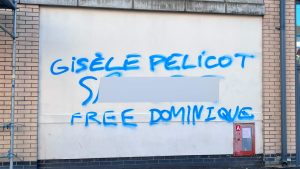
Like the violence perpetrated by Dominique Pelicot and the other men involved in the abuse of Gisèle, this graffiti is also not exceptional and nor should it be dismissed. It is symptomatic of broader and surprisingly common viewpoints across NI society. The graffiti has appeared against the backdrop of the conviction of Jeffrey Donaldson of 18 counts of non-recent sexual offences, which all occurred when the victims were children, including one count of rape. Donaldson, at the time of his arrest in March 2024, was a Member of the UK Parliament and leader of the largest Unionist party in NI (DUP). His wife, Eleanor Donaldson was also found guilty of aiding and abetting in a simultaneous trial of the facts. The graffiti appears against the backdrop of alarming rates of femicide in Northern Ireland, where 30 women have been killed by men since 2020 and many of them by a partner, ex-partner or someone known to them. And it appears against the backdrop of a period of racist riots across Belfast in June 2026, for the third year in a row, where homes were burned, public infrastructure was set alight and lists containing the names and addresses of migrants were shared across social media.
When read within their context, it is clear to anyone that the graffiti, and how it came to appear, are not exceptional and nor can they be ignored. They are symptomatic of an increasingly pervasive misogyny and racism in NI. Speaking to The Irish News, the anti-racist group End Deportations Belfast said that Northern Ireland has become a ‘hotbed’ for international far-right actors who arrive here with nefarious intentions. NI is not entirely distinct from other contexts when it comes to the presence of anti-immigrant sentiments, misogyny and shifts towards the right. But the misogy-tourism goes to show that these attitudes, and acting on them, are viewed by at least some as permissible and even acceptable here.
I can’t help but feel angry, despondent, frustrated, frightened even. Is this a symptom of the legacies of state and sectarian violence in Northern Ireland? As someone who grew up in West Belfast and born one year (almost to the day) following the signing of the 1998 peace agreement, I’ve spent much of my life, academically and otherwise, preoccupied by the commitments to peace in this region. For me, and many others, those go far beyond commitments to the end of violence understood in terms of bombs and guns (so to speak). Those include commitments to gender equality, to racial equality and to more broadly building a society on foundations of socio-economic equality and non-discrimination. Those are written into the tapestry of NI’s constitutional order, thanks to the work of women and feminists (e.g., the Northern Ireland Women’s Coalition) who fought tirelessly to have them included. Those are the commitments that both the British and Irish governments have agreed to uphold in relation to NI. Better still, the importance of those commitments was reaffirmed after Brexit. Cough, Article 2 Windsor Framework, perhaps one of the only elements of the Brexit arrangements relating to NI that didn’t shapeshift into unrecognizability at one point or another during the negotiations.
But disappointingly, as Aoife O’Donoghue has written about on this blog and elsewhere, we needn’t look any further than the UK Supreme Court’s decision in Dillon in May 2026 to see how the scope of those commitments can be diminished, narrowed and eroded. Looking beyond the judgment’s colonial undertones, it makes clear that the court views the rights set out in the Good Friday Agreement only through the lens of sectarian conflict. An already narrowly specified right (that of women to full and equal political participation) becomes further narrowed. In the context of the horrendous graffiti, June’s riots, the levels of misogyny and abuse experienced by women in NI (including in political and public life) renders the Supreme Court’s interpretation quite frankly tone deaf.
It’s not all bleak, though. Northern Ireland and Belfast are home to vibrant channels of feminist organising and activism. Our feminist solidarity and activism often stretch across borders and traverse the globe. And they are all the stronger for it. Where courts and other arms of the state fail to adequately respond to many of these events, it is communities, activists and feminists who fill in the gaps. Sometimes doing the protesting and the campaigning, and often in very difficult circumstances. At other times, filling in the gaps means doing the quiet work of resistance like raising funds, driving children to school exams when public transport wasn’t safe, delivering groceries or providing safe spaces across Belfast. That work should be recognised and valued in the context of state failures to respond to and address blatant displays of misogyny and racist violence in NI.
If that horrible graffiti tells us anything, it’s this: Northern Ireland is grappling with problems that stretch so far beyond the ‘two communities’, and we require solutions that go far beyond that orientation. It also tells us that we can’t neatly disentangle these issues. Where there’s racism, there’s misogyny, and where there’s misogyny, there’s racism, along with a whole host of other structural inequalities and systemic prejudices. Any constitutional rights or equality framework that is going to lay the foundations for a truly ‘peaceful’ society here needs revised, reoriented and maybe completely reimagined to reflect that.
Aislinn Fanning is a Leverhulme Early Career Fellow at Newcastle Law School
Discover more from Doing Feminist Legal Work
Subscribe to get the latest posts sent to your email.