
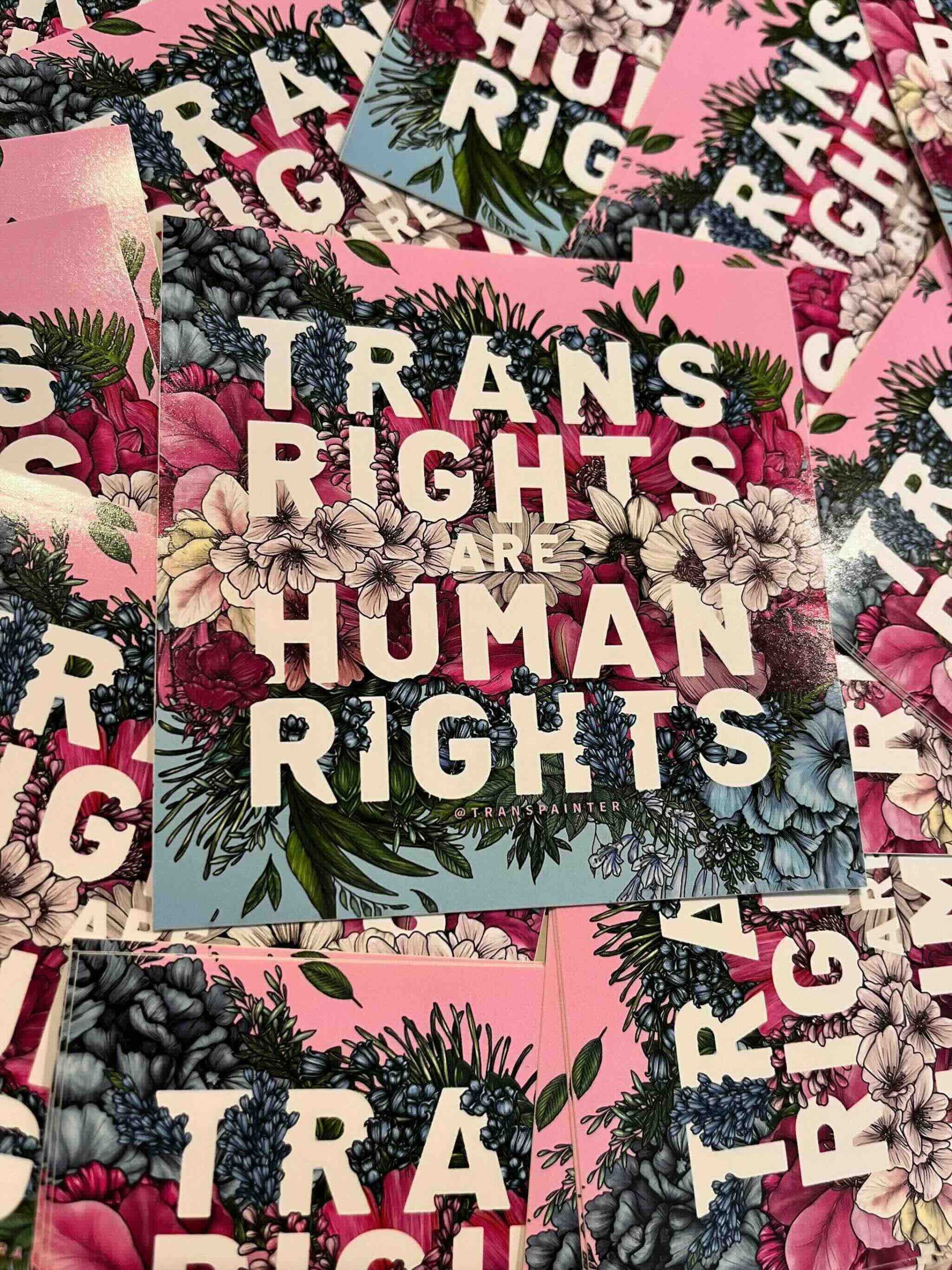
 I have been mulling on the phrase ‘trans rights are human rights.’ Of course they are; no-one at this blog would contend otherwise. We chant it at protests, wear it – sometimes literally – on our sleeves. But what happens when the trans person becomes separated from the universal construct of the human? What happens when legal and social citizenship are stripped from this class of persons, and they become abjected? These are not theoretical questions, although they are couched in the language of legal theory. Trans people are being subjected to increased legal and administrative violence in many jurisdictions, including the United Kingdom and the United States. The regulation of trans life comes in many forms, from the bureaucratic (such as issuance or denial of documentation) to the material (such as access, or denial of access, to medical interventions). What each of these pieces of regulation adds up to is the denial of full citizenship to trans people on the basis of their gender identity – a kind of legitimised, regulatory, discrimination. Are trans rights really human rights? When it comes down to it, do the institutions which govern our lives consider trans people to be fully human?
Following Donald Trump’s Executive Order of January 20th, 2025, on “Defending Women from Gender Ideology Extremism,” the US State Department has ceased to process passport applications from applicants seeking to have an X marker on their passport (often used by nonbinary people) or to change their passport marker from M to F, or F to M. This leaves trans people with the choice of having either a passport with the incorrect gender marker on it, or of having their movement in or out of the country denied – a right which is bestowed on every other citizen of the United States. It is clear that the citizenship of trans people is being considered lesser than that of their cisgender peers.
Cossman tells us that citizenship includes
not only legal and political practices but also cultural practices and representations… I also see citizenship as invoking the ways that different subjects are constituted as members of a polity, the ways they are, or are not, granted rights, responsibilities, and representations within that polity, as well as acknowledgement and inclusion through a multiplicity of legal, political, cultural and social discourses. (Sexual Citizens, 2007, 5)
The decision to deny trans people correct identity documents, forcing them to choose between the reality of their gender and their ability to exercise free movement on a par with cis people, is an obvious denial of their full legal citizenship. However, it also erases the existence of trans people from the public record and prevents their full participation in public life. If we are to follow Cossman’s definition, it can also be seen as revoking their social citizenship – the rights, acknowledgements, and inclusions which are bestowed on people as members of not just a legal jurisdiction, but of a society.
Kristeva writes that the abject is “something rejected from which one does not part… what disturbs identity, system, order. What does not respect borders, positions, rules. The in-between, the ambiguous, the composite.” (Powers of Horror, 1982, at 4) Cisheteropatriarchal society upholds binary, heterocentric norms defining who is a legitimated sexed/gendered subject. The liminality of trans people’s societal status thereby positions them as easy candidates for the denial of citizenship. From there, it is a short step to social abjection – for from the point of view of the State and of the macroscopic social apparatus, the non-citizen is an uncitizen, and the law considers an uncitizen to be an unperson.
The creation of unpersons and their concurrent removal from public life is possible because these objected lives are not seen as grievable. ‘Grievability,’ Butler tells us (Frames of War, 2009, at 14), ‘is a presupposition for the life that matters.’ (Of course, they (Butler) would also problematise that sentence – asking who the ‘us’ is and whether that ‘us’ would form part of the grieving.). An ungrievable life, therefore, is one which does not matter, or which may as well not be lived. The ouroboros of ungrievability is seen in the operations of the Trump administration toward trans people – because they are not seen as full citizens, fully possessed of personhood, it is permitted to take more markers of citizenship from them, rendering them even lesser citizens.
So are trans rights human rights, and if not, how can they be rendered more so? One strand of thought which diverges from the liberal account of state recognition is radical transfeminism, as described by Raha and van der Drift. In Raha’s words, radical transfeminism is
a collective political praxis and critique developing in the tenuously United Kingdom and Europe, centering transfeminine bodies that are or find themselves precariously employed, poor, overworked, and pathologized—bodies of color and various shades of white; migrant bodies; dis/abled bodies; and/or “working” bodies. Radical transfeminism is oriented around forms of care and support, and through working together, over and across material precarity. (2017, 637)
Radical transfeminism builds on Stryker’s concept of the non-normative or anti-normative body as a site of knowledge production (242). It respects the epistemic authority of trans people, particularly trans women, in the creation and cultivation of collective intellectual agency and resources. Raha and van der Drift distinguish between trans liberalism and trans liberation (Trans Femme Futures, 2024, at 79), with the former being a reliance on State and institutionality for recognition and the provision of material needs, and the latter entailing ‘support and solidarity’ among trans communities in order to circumvent or mitigate the need for institutional validation and recognition through practices of mutual act and care ethics. Trans liberation requires an institutionally abolitionist outlook which denounces the need for administrative and medical obstacles to the provision of needs for trans people, and to their susceptibility to abjection, criminalisation, and marginalisation, under the carceral State. Radical transfeminism is therefore a politics of agency, a defiant statement of the grievability and meaning of trans lives.
If the slogan ‘trans rights are human rights’ is ever to be anything more than hollow words, society must start with the recognition of the real humanity of trans people and the worth of their lives and social participation. Unfortunately, reading the currents of domestic and global social discourse, as well as the quantifiable political and legal acts put into force by Donald Trump, Wes Streeting, and others, it does not seem that this is the way the wind is blowing. Therefore I feel it is incumbent on feminist lawyers to become advocates not just for trans liberalism – which is where legal advocacy often stops – but for trans liberation also. It is difficult and often paradoxical work, to resist gendered norms when working inside a structural framework such as the law, but it has become a matter of urgency that the tide of anti-trans and anti-gender politics is held back. As Stryker writes (251), “May your rage inform your actions, and your actions transform you as you struggle to transform your world.”
Dr. Sandra Duffy (they/she) is Lecturer in Law at University of Bristol Law School where they teach human rights and health law with a focus on gender and sexuality. They are currently working on their first monograph on the regulation of gender in postcolonial states.
Discover more from Doing Feminist Legal Work
Subscribe to get the latest posts sent to your email.