
“It was like an epiphany. We just felt a weight lifted off us to know that there was even an option. They told me someone local to me where I could go and that was it. I just felt like someone was caring” (An interviewee for Ireland’s unplanned pregnancy and abortion care (UnPAC) study, 2022)
“I am at the hospital because I have taken tablets for a medical abortion but the pills didn’t work. I am still pregnant at 12 weeks and 3 days and the hospital said they can’t help me any further” (An Irish abortion-seeker quoted in the Abortion Support Network’s newsletter of 26 September 2025).
Ireland’s new system of abortion care shows that significant systemic change towards reproductive justice is possible, even in hostile times. Thousands of lives are getting relief from unsupportable pregnancy, and gaining some freedom to make life with others on their own terms. A fee-free publicly supported abortion service is being made available up and down the country through GP-led community health care in the first 9 (+6d) weeks of pregnancy and in maternity hospitals after 9 weeks. Abortion-seekers no longer risk criminalization, even if they have an abortion outside the terms of the legislation, as the Health (Regulation of Termination of Pregnancy) Act 2018 (the 2018 Act) makes them exempt from its criminal offences. They are free to avail of their state’s public abortion care or to seek the independent support of feminist organisations such as Women help Women and the Abortion Support Network. But we know this is not enough.
The new abortion infrastructure shows us how reproductive inequalities linger after feminists have succeeded in changing the legal terrain. Lawful abortion pathways are still being interpreted through a foetocentric lens to the disadvantage of pregnant people. And old and new hierarchies among life-makers mean that some of those who can get pregnant are deemed less worthy of recognition and support than others. Even if those who are eligible for ‘early’ abortion care face fewer barriers in a post #repealthe8th world, the 12 (+0d) week legal time limit operates as a harsh cut off point, and the lawful pathways after 12 weeks are narrow and difficult to access. The free public abortion service is not as accessible as it could be, especially for those made ‘late’ by their life circumstances, inevitably in brutally unequal terms. And criminalisation still threatens abortion providers and supporters who are not exempt from the rights-reducing and disproportionate new criminal offences in the 2018 Act, even if they can defend themselves legally on good faith grounds. What kind of feminist legal work is called for now?
 This blog series on legal witnessing after #repealedth8th makes some space for answering that question. Here legal witnessing is a short-hand for the collection of critical feminist practices that involve active observation of law as it impacts on everyday life in order to repurpose that impact and use it to make an intervention towards transformative justice. This kind of witnessing belongs to the feminist legal commons as shared expertise; it is not owned by any one in particular. We can see legal witnessing and the generation of transformative legal knowhow in the work of organisations like Justice for Magdalenes or the peer support of organisations like the National Traveller Women’s Forum, as well as in the reproductive justice campaigning of the Abortion Rights Campaign. Anyone can witness by accompanying another in observing the force of law on life and joining together to push back. Witnessing is partial, situated and multiple. There are times when it needs to become professionalised, research-led, or specialist to make its intervention. But witnessing is always accountable to everyday people and their experience of law. That everyday accountability is what gives witnessing its power and makes it different from the kind of legal practice that affirms authority and violence in the name of law. As critical praxis, witnessing works to replace brutalising legal authority with careful legal engagement through three related kinds of activities: a) observing how law is concretely situated in everyday life, b) retrieving law’s multiple and diverse sources, and c) opening law up to different possible applications.
In picking up the shared collection of legal knowhow acquired through repealthe8th and beyond, the series seeks to tackle some concrete legal problems in a post repealthe8th world. By generating a composite of different partial perspectives, would we engage what feminist epistemologist Sandra Harding called ‘strong objectivity,’ or the kind of objectivity that is the sum, rather than the generalisation, of our parts? Witnessing thinks about what is being seen in material and therefore materialist feminist terms: the legal objects that we observe have been made in the world, and can be unmade and remade. Even if this is so, it is not easy to unmake and remake law, because powerful forces, that work on and through us consciously and unconsciously, have made law what it is. We #repealedthe8th but the powers that seek to keep reproducers in place, and at pace, have not gone away, indeed they are regenerating themselves in ways that are challenging to anticipate.
Witnessing the role of soft law guidance
As we look at problems and challenges in a post repeal world anew, one observation that came out of a May 2026 gathering of legal witnesses at QMUL (as discussed by Smietana and colleagues), is that there is more to do and say about how soft law[1] is contributing to the understanding of what kind of abortion care can be made available. Soft law is the collection of non-binding legal rules such as guidance and codes of practice that have significant legal effects, but in different ways to that of hard law with its binding, enforceable legal rules. What role has soft law played so far in enabling the implementation of Ireland’s new lawful abortion service?
When we look back we can see that soft law has actually played a significant role in bringing about hard legal change since the referendum campaign. The General Scheme of the Health (Regulation of Termination of Pregnancy) Bill 2018 document that was published by the Department of Health in the run up to repeal was in effect a piece of soft law. It was a set of rules that had a practical function in educating people about how the law might work in future. But it was not adopted as a binding piece of hard law because it was not actually part of the Bill that went through the Oireachtas to enable the referendum to take place and change constitutional law. The actual Thirty Sixth Amendment of the Constitution Bill 2018 was put before the Oireachtas in March 2018 and adopted as an Act in September 2018 after the successful referendum on May 25th. It replaced the text of Article 40 3 3 and simply states: 3° Provision may be made by law for the regulation of termination of pregnancy. The General Scheme has never had the force of law, because it was not a necessary or normal part of the usual legislative process, even if played an important role in enabling legal change.
Rather, as a legal source, the General Scheme was a Department of Health communication about key minimum standards of regulation, e.g. that abortion would be on request in the first 12 weeks of pregnancy, to which the government of the day had committed publicly during the reform process. It was part of public health planning as the Minister for Health, Simon Harris, sought to move the case for repeal along by laying out the key aspects of the anticipated new abortion law in the wake of the Citizens Assembly and the Joint Oireachtas Committee Report. The idea was that people should have a general understanding of the likely legal picture that would result from their vote. It was part of the educational effort in familiarising people with the commitment to make abortion generally lawful in the first twelve weeks of pregnancy, and not to maintain a purely exceptionalised approach to abortion where pregnant people would have to prove that they met particular legal grounds for abortion. But publishing information about government plans is just that, important information at a given moment in political time. It is not a step that alleviates legislators of their public responsibility to scrutinise and review legislation and to work through the best particular ways of legislating in light of evidence and experience, and on behalf of the people. Understanding the difference between soft and hard law as two kinds of legal sources, and how they relate to each other, is key to removing some of barriers that have been erected by conflations between them.
Since the passing of the actual legislation in the shape of the Health (Regulation of Termination of Pregnancy) Act 2018 (the 2018 Act), another piece of soft law, the Health Service Executive’s Model of Care has had a significant impact in enabling implementation of the law and delivery of abortion care. The integration of telemedical methods of abortion delivery is a key example of how a change to this soft law source enabled improvements in accessibility and more rights-promoting legal implementation. As explained by Spillane and colleagues, in 2020 the HSE changed the Model of Care in order to facilitate remote appointments and remove the barrier of in person meetings when that is not necessary for the delivery of safe abortion care. This was initially motivated by the emergency context of Covid19 and the need to reduce contacts while enabling abortion care. But it was ultimately routinised as a valuable aspect of contemporary abortion care. In other jurisdictions, the legal infrastructure required parliamentary intervention and a hard law change in order to enable remote access to abortion because of legislative requirements about the place of abortion’s delivery. But in Ireland, this major achievement for accessibility has been enabled and sustained by soft law measures to date.
Other kinds of soft law – clinical guidelines in particular – play, and have played, vital roles alongside HSE and Department of Health policies and communications in translating the legislative framework into an operational system. But if soft law can be a powerful tool for fleshing out the legal infrastructure and raising standards of care, it can also work as a troubling block or gap in care. As I explain further in Witnessing Legal Sources of Time, current guidelines on a range of legal issues, including the operation of the 12 week time limit, the scope and meaning of a risk of serious harm to health and/or a risk to life, and the understanding of ‘likelihood’ for access when the foetus has a condition likely to lead to death, do not yet take on board the full range of legal options they have available to them for implementation. They could draw on other legal sources to adopt more rights-respecting and harm-reducing perspectives. In reflecting on interdisciplinary methods for doing this kind of legal work, including by engaging with arts-based methods to imagine what better abortion care might be, we thought it would be helpful to understand more concretely how some of the soft law measures are operating on particular issues. That is why we focus on a particular legal problem i.e. failed EMAs with this series, but consider it from a range of different perspectives.
Witnessing soft law exclusions of ‘illegal’ follow-up abortion care
“I have been fully informed of and understand to my complete satisfaction: …if my abortion fails and I have an ongoing pregnancy that goes beyond 12 weeks of pregnancy, it is illegal for a doctor to provide an abortion unless there is a risk to life or health, risk to life or health in an emergency or condition likely to lead to death of foetus” (HSE medical abortion consent form)
Soft law on abortion care is not only fleshing out the hard or binding legal framework in practical ways, with guidance, plans and models of care. It is also having an impact on how the hard legal boundaries of that framework are understood, including in some cases by declaring what is illegal. We can see this most clearly perhaps in the case of the provisions in the guidance, and in the medical consent form which the guidance underpins, which related to ‘failed’ EMA up against the 12 week time limit. As things stand, key soft law provisions in the HSE’s Model of Care (2023: 27), the NWIHP guidelines (2022: 20), the ICGP Quick Reference Guide (2025: 25), and the original IOG and RCPI Interim Clinical Guidance (2018: 8), all state that it is illegal to provide follow up abortion care after a failed EMA in cases where the pregnancy is ongoing and more than 12 weeks gestation, unless the exceptional grounds under ss. 9-11 of the 2018 Act apply. This applies even though an early medical abortion has been lawfully certified and attempted before 12 weeks, but ‘failed’. They also say, in agreement with other national and international advice and guidance on this issue, that best clinical practice in cases of incomplete medical abortion is to complete the abortion, whether by providing another dose of pills or by providing a surgical abortion.
There is clearly a tension, as Murray points out in her contribution, between best clinical practice (as informing the legal standard of care at common law) and practice as apparently required by the 2018 Act, which is unhelpful to say the least. In order to figure out what can be done about this harmful situation, especially as we recommit to facilitating safer abortion on International Safe Abortion Day with peers, colleagues and comrades around the world, we have some questions. How has a failed EMA come to be seen differently to an incomplete EMA? What legal sources are being relied on for this statement of illegality? Are there other relevant legal sources that could apply? Moreover, is the current application of the relevant legal sources to the fact situation of failed/incomplete EMA sound in light of the legal possibilities, the lived experience of EMA, and the objectives of reducing harm, promoting rights and enabling care?
If the current barrier to safe abortion in cases of failed EMA after 12 weeks is a soft legal one, it falls to the relevant bodies – namely the Department of Health, the Chief Medical Officer, and/or relevant the professional colleges – to use their jurisdiction to replace it with better guidance. At the moment, they seem to feel that their hands are tied and that they are prevented from adopting better policy and practice by The Law. But is this necessarily so? And what can be done to replace chilling and brutalising legal authority with warmer and careful legal engagement? There is a specialist question here for lawyers as to whether the current legal framework actually requires the current policy interpretation, or whether it is one among a number of possible legal options, or indeed whether it is ill-advised on the grounds of conflict with legal norms. At the moment, the only legal advice that is publicly available on these questions as they have informed policy developments and their review, is a letter from the Chief Medical Officer, a letter from the Department of Health (both available as appendices in the 2018 Guidelines), and a recommendation from barrister Marie O’Shea in the independent review (2023) she conducted for the Department of Health. While all of them provide some insight, none of them exhaustively answer the question as to whether the current policy position is legally required, and none of them apply hard legal sources to answering the question in any detail.
The 2018 letter from the Chief Medical Officer that is cited in the original 2018 guidance (appendix 2) on early medical abortion appears to rely on a Department of Health legal view that 12 weeks needs to be counted as 12 weeks + 0 days. No clear legal source for this position in cited, but the implication is that the 2018 Act requires 12 weeks to be counted in this way, rather than in the conventional obstetric way of counting 12 weeks as 12 weeks + 6 days. This is a mechanical approach to time which fails to engage with statutory methods of interpretation or to address the possibility that ordinary time runs cyclically and not just according to the mechanical clock. The possible relevance of a cyclical approach to time is sourced in the statute itself and its recognition of cyclical menstrual time as the reference for marking the beginning of the gestational time that is counted by the 12 week time limit. But even if the soft law of the Chief Medical Officer’s approach were to become hard law in future through a court interpretation, that still doesn’t explain why a 12 weeks + 0 days time limit cannot be applied in a way which recognises that abortion itself is a process that may require pausing of the 12 week legal clock until the legally certified abortion is complete.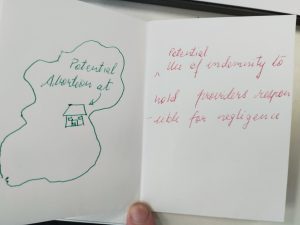
Moreover, the Department of Health letter (appendix 3) on which the 2018 guideline relies (for its position against resolving failed EMAs after 12 weeks) explicitly states: “It is recognised that in some circumstances the process of completion of the termination may extend beyond 12 weeks.” As Conlon and colleagues explain in their piece, this has been interpreted as allowing repeat doses of misoprostol to complete an abortion after 12 weeks, and enable the evacuation of any remaining tissue, but it has not been interpreted as allowing a repeat dose of mifepristone or the complete medical abortion regimen. And as Smietana and colleagues discuss, research into the actual experience of abortion timelines across a range of jurisdictions, raises a host of questions about how law might interpret different moments in abortion as a process rather than an event. There is no obvious legal reason why different effects of the process should be distinguished in such binary legal terms. Or, at least in so far as the most likely explanation is a hidden or unconscious foetcentric approach, that is one that not only is not endorsed by the current legal framework, but has been actively rejected by the referendum vote, as Taylor notes. Rather, as Martin and Murray discuss respectively, the current policy position seems to contradict state obligations to respect rights and to challenge the legal standard of care in negligence law.
O’Shea notes in her review that the legislation does not allow for the extension of the 12 week time limit, and therefore that there does not appear to be a means for resolving the problems documented in the empirical research with failed EMAs not being allowed to complete (2023: 91). She finds this ethically troubling. Consequently, she recommends that the 2018 Act should be amended in order to allow the completion of abortions that have been lawfully commenced under s 12 of the Act (2023: 25). Certainly legislative change is one option available for addressing this problem, but that does not in itself negate the possibility that the current legal framework, especially when interpreted in light of rights and care commitments, may provide other options. O’Shea herself did not engage in a fuller human rights analysis, or in an assessment of the compatibility of abortion law with other legal standards of care, including the minimum standards implied by duties to avoid negligent, less-than-best- practice, care (see Murray this series). These avenues are still on the table as a result. And even if the legislative avenue for addressing this problem was taken as O’Shea recommends, and an extension to the time limit in certain specific circumstances became legally possible, there would still be a need to do legal work on implementation of that exceptional pathway.
If it is legally possible to adopt new and better guidance on the failed EMA issue, how could legal witnesses best contribute to a case for change? The blogs that we share in this series answer this question in their different ways, and we would welcome hearing from others who have insights, expertise and suggestions to share. Kumar reminds us that abortion work moves across borders and generates people-powered community as the Abortion Support Network respond to those who call on them, including 13 as a result of timing-out after failed EMAs. Horgan, Walsh and Creswell testify to the richness of existing health care professional commitment to destigmatising abortion and replenishing repealing communities by breaking down borders and barriers on and around the island of Ireland. The photographs that accompany the blogs are some of the artefacts that emerged from our composite and collaborative conversations as Emma Campbell and Anna Schmid facilitated a creative arts session. Together the people, texts and images that move in and out of legal witnessing practices find ways to weave new and adapted careful abortion pathways for all, including those who experience failed EMA up against the harsh time limit.
Ruth Fletcher is a Professor of Law at Queen Mary University of London, former chairperson of the Abortion Support Network, and a lawyer for choice on the pathway to transformative reproductive justice.
[1] As Sekalala and Masud say: “Although hard law is binding and soft law is not, the distinction is actually more nuanced. Legal norms are not binary, but are based on graduated normativity, from binding to non- binding” see further: Sekalala, S., & Masud, H. (2021) Soft law possibilities in global health law. Journal of Law, Medicine & Ethics 49(1), 152-155, p 152; available at: https://wrap.warwick.ac.uk/id/eprint/161130/1/WRAP-soft-law-possibilities-global-health-law-Sekalala-2021.pdf. For an account of how a range of binding and non-binding, hard and soft, legal sources are relevant to conventional and critical legal analysis, including the interpretation of the 2018 Act, see Fletcher (2025): 133-134 on ‘identifying relevant legal rules’. More generally see on soft/hard law dynamics see: Merry, S E Firming up Soft Law: The impact of indicators on transnational human rights orders, chapter 11 in Halliday T and Schaffer G (eds) (2015) Transnational Legal Orders Cambridge University Press.
Discover more from Doing Feminist Legal Work
Subscribe to get the latest posts sent to your email.