
For many who need or provide abortion in Ireland, wonderfully, it has been part of routine healthcare for all their reproductive lifetimes or careers. Its provision is taken for granted. For the Irish Family Planning Association (IFPA), which spent years convening experts and activists to consider what kind of legal framework might be most effective in delivering rights, the perennial question—what is law doing in reproductive healthcare?—remains. The answer hasn’t changed: from a healthcare perspective, it is mostly obstructing access.
When I began to reflect about what I could contribute to the legal witnessing workshop on the denial of care after a failed medication abortion, I decided to look back at the time between the referendum and the beginning of abortion care and attempt a retrospective sketch of what I recall of the context this policy emerged from. There are gaps in my and the IFPA’s experience, most particularly in relation to the processes within the Department of Health, the Health Service Executive (HSE) and the professional bodies. But I had a vantage point in 2018 and 2019 that provides useful insights into the series of imperfect, sometimes regrettable, and occasionally rushed decisions made, and positions taken, under extreme pressure. These insights raise useful questions about the ways laws, policy and guidance interact in practice and how interpretations harden into positions which can come to be considered part of law.
And, with a few years critical distance, I am more able to acknowledge the human dimension of these processes during the final months of 2018 and the early weeks of 2019. Government officials, healthcare providers and professional bodies, many of whom had campaigned for repeal, were doing their best under great pressure to figure out how to navigate the act’s limitations on eligibility and criminal provisions and ensure access to abortion care. In different circumstances, with a longer lead in time and more planning, things might have been resolved differently, but we only have the set of things we know to have actually happened to reflect on. These key moments, and what I termed “vibes” at the workshop, are better described by borrowing from the work of Sheelagh McGuinness on ‘governance mood’ and the ‘affective and aesthetic dimensions of jurisdictional arrangements.[1] I was clear that I was presenting a partial and subjective timeline of touchpoints on the way to the current policy settlement. During the workshop, it emerged, unsurprisingly, that among those who were involved in those stressful times there were different recollections about some points. After a little googling, it turned out none of us was quite correct. I’ve corrected my timeline accordingly and confirmed some details with colleagues; there is more to be said and written to fill in the gaps.
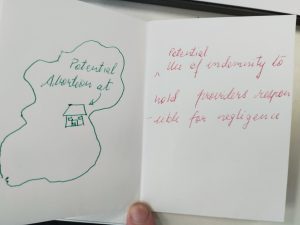
During the workshop I was sitting across from a screen across the bottom of which I could see the AI software scribbling away, capturing my repeated comments about how little I was enjoying thinking back to this period, and committing a series of misheard infelicities to the record that nicely counterpointed my slightly mixed-up chronology.
May 25th, 2018: the referendum and the 1,429,981 yes votes; 66.4 % of a very high turnout. The result was clear from an RTÉ exit poll published before the final count.[2] Notably, the poll found 61% believed abortion should be freely available in Ireland to any woman who wants to have one; 62% cited women’s right to choose as an influencing factor, which is useful to recall when politicians claim that the letter of the current law is what we voted for. Indeed, according to polling the IFPA commissioned last year, the vote would be higher if we had the referendum today: 69% of those polled believed that the law should be changed so that any woman who needs an abortion can access it in Ireland.
May 26th, 2018, on the balcony of Dublin Castle, the Minister for Health, Simon Harris, declared that services would begin on the 1st of January. Good news: implementation doesn’t always follow law reform so quickly, but we were not going to have to wait years for legislation and a model of care. But this commitment created an exceptionally rushed timeline for legislative scrutiny. Ostensibly because there had been a citizens’ assembly and an extensive joint Oireachtas committee on the 8th amendment in 2017, each of which published lengthy and mutually reinforcing reports, the government parties saw no need for more discussion. However, neither of those processes looked at the specifics of what a legal framework could or should be or took a critical perspective on how the law should best be drafted to support access to quality healthcare. The government was keen to push the legislation through, and that level of consideration simply didn’t take place.
Governments tend not to overflow with creative lawmakers, but more engagement between the Oireachtas health committee, healthcare experts, civil society and department officials could have aided the process of developing a piece of healthcare legislation focused on ensuring access. Instead, the drafters took the 2013 Protection of Life During Pregnancy Act as the starting point and tried to shoehorn the legislative scheme that had been published two months before the referendum into it. The people had voted to repeal a constitutional abortion ban, which was one of Europe’s and the world’s most restrictive abortion laws whose entire aim was to keep abortion out of the law and healthcare system, and to entrust the power to regulate abortion to the Oireachtas. And then the government took the act that gave expression to the old law and tried to build regulation of an abortion service into it. A non-lawyer might question whether ignoring the vibe of Bunreacht na hEireann and the spirit of repeal in this way was constitutional or morally right. At a meeting to mark international abortion providers appreciation day in March this year, most of the doctors and midwives present had had to deal with utter disbelief when people find that they are ineligible under the law and must travel to avail of abortion. Didn’t we vote to end that?
Coming back to the vibes, the frequent characterisation of the referendum process as a collaboration between government and civil society, while simplistic, captures an unusual closeness between some organisations to the then health minister, Simon Harris. Understandably so, at a human level: they had campaigned, achieved success and celebrated together. But I think a degree of critical distance was lost along the way, and this had material impacts. Perhaps inevitably, the exhaustion, fallout, falling outs, settling down and moving on after a very long campaign left many campaigners without sufficient stamina for legislative scrutiny as the bill sped through the Oireachtas in the autumn of 2018. There isn’t scope here to discuss either the rights-supporting provisions or the flaws, but the approach certainly didn’t engender an entirely rights-based law.
In parallel with the passage of the legislation through the Oireachtas, future providers were asking what the services that were to begin on January 1st would look like? How would they be provided and how would this be funded? How was the model of service delivery being developed and by whom and when? When would training, protocols and practice directives be made available? As far as I have ever been able to determine, between May and September precisely nothing was happening. A key abortion advocacy message is that it is a healthcare service like any other and as such has no place in the criminal law. It began to seem that policy makers took the first part of statement literally to mean that there was no need to do any planning. Moreover, there were concerning hints from officials that provision of early abortion on request under s.12 might be limited to GPs, and that the IFPA and other specialist reproductive healthcare providers would be excluded. This may have been an unintended outcome of one of the referendum campaign tropes, namely that Ireland would not go the British route of abortion clinics (as if that were an obviously bad thing).
Back to the timeline, by September, there was considerable concern among the potential providers. Two critical events that month galvanised the healthcare community to push for some action. During the biennial FIAPAC[3] conference, held in Nantes, France, IFPA colleagues Alison Spillane and Dr Caitriona Henchion, organised a meeting of the Irish doctors who were present, including Dr Mary Short, then director of women’s health with the Irish College of General Practitioners (ICGP). Drs Henchion and Short began to sketch out a model for primary healthcare provision. At a workshop convened by the World Health Organization (WHO) human reproduction programme in Dublin to share insights from a research project, representatives of the hospitals, professional bodies and providers realised that nothing seemed to be happening: no task force or expert advisory group, no consultation, no engagement. Finally, from October, and not without prompting, the health minister and chief medical officer (CMO) began to hold meetings with potential providers. The tense atmosphere created little confidence, despite the minister’s confident assurances that problems would be resolved by the review in three years’ time.
And at the same time, there was political work to be done to try to get some amendments to change some of the obviously unworkable elements of the proposed legal framework before the bill was signed into law. The criminal provisions, initially placed in the opening sections, were moved to the end of the act.[4] While the government resisted all the health-related reasons for objections to the mandatory waiting period, the original requirement, in complete disregard for practicality, that the same doctor would have to see the pregnant person on either side of the three mandated days, was amended. These were modifications to the bill’s provisions; the only significant amendment was the inclusion of the review clause,[5] which would go on to enable the Independent Review carried out by Marie O’Shea. The idea was proposed by civil society, based on the model of the Gender Recognition Act 2015, and was hard fought for, as my colleague Alison Spillane recalls. Ironically, given how frequently he would invoke it as the means of solving any and all flaws in the act, it was initially resisted by the minister for health.
 Wheels were beginning to turn within the Department of Health and the HSE, including a very accurate estimate of a probable 10,000 abortions per year[6] and an appropriate budget, but it was effectively left to the professional bodies to fill the gap with respect to developing protocols, policies and referral pathways. While abortion is not generally a complicated area of healthcare and does not require significant training beyond the existing reproductive healthcare skillset, it’s not nothing. Complications can arise; providers need training, guidelines, protocols and referral pathways. In the context of the profound change represented by the referendum, it felt as though the health department essentially provided no leadership for its development. A generous interpretation might be that this was a deliberate strategy to ensure that the professional bodies stepped into the leadership void; the feeling I recall was more of an attitude of, you’ve made your bed, referendum wise, now lie in it. Since the workshop, I have reread an account which draws on interviews with HSE and Department of Health officials, whose perspectives are completely different and recall aiming for “a collaborative approach by engaging stakeholders, through open input, and maintaining a constructive attitude”.[7] Both perspectives are valid, and such contradictory readings of engagements between civil servants and civil society are not unusual.
As the January 1st start-date for services approached, individuals within the professional bodies visited peers in the UK to gain insights into their practice and protocols for terminations. The WHO human reproduction programme carried out values clarification workshops at maternity hospitals throughout December. Yet, despite the generous engagement of these and other international colleagues and expert bodies with the Citizens’ Assembly, the Oireachtas committee on the 8th amendment and the referendum campaign,[8] there does not appear to have been a state-led policy of drawing on expertise from outside Ireland.
However, a collaborative group was established, including representatives of the HSE, health department and providers. This met periodically through the autumn, with the HSE National Women and Infants Programme driving the process. The issue of the upper gestational limit came up frequently, albeit in the context of how to interpret 12 weeks in general, rather than TOP specifically. When it was suggested that in obstetrics, any number of weeks extends to that number plus 6 days, the categoric view of the CMO was cited: 12 weeks was to be interpreted not as commonly understood in pregnancy care, but literally as 12 weeks + 0 days.
The felt attitude of the state, combined with high expectations and intense public and media interest, created an atmosphere of intense anxiety, stress and uncertainty as December approached and uncertainty prevailed about what the service would actually be like. There was a scramble to get training for providers in place, much of it through the solidarity of the international community of abortion care experts, including the WHO, Doctors for Choice, and the British Pregnancy Advisory Service (bpas). WHO representatives travelled Ireland to provide training in values clarification for the major maternity hospitals and bpas provided training for the emerging START group of doctors.
And then it was January. The first clients on the phone, some close to the gestation limit as they’d been waiting for abortion to become available in Ireland, rather than having to travel for care. No one knowing initially whether their local GP was a provider, or how many GP providers there were. Only ten of the maternity hospitals providing initially. GPs having to figure out referral pathways to the maternity hospitals as the hospitals grappled with referrals from locations outside their catchment areas with no local hospital provision. Teething problems with My Options, the information line, and Affidea, the scanning service. The anti-choice groups: one of which set up a website to mimic My Options; others were offering fake scans and biased counselling to try to mislead women and prevent them accessing abortion. A whole new set of paperwork required so that each abortion could be notified to the minister as stipulated by the new act. Intense media pressure, with journalists desperate to get the scoop on the first cases. Figuring out the practical application of the fetal anomaly and health provisions and the appropriate role of multidisciplinary teams in deciding on eligibility. Dealing with the impact of refusal of care under the conscientious objection provision. Trying to figure out how best to ensure timely care within 12 weeks gestation despite the mandatory waiting period.
The question of how exactly 12 weeks should be interpreted landed into this fraught context. At the workshop, there were different memories of precisely where the answer came from and at what point—the chief medical officer (CMO) or the attorney general? The December 2018 Institute of Obstetricians and Gynecologists (IOG) guidance[9] cites a letter from the CMO from November as the source of the absolutist 12 weeks+0 days interpretation. The issue had been discussed within the collaborative group. The Irish Times reported in late January 2019[10] that the CMO had apparently been asked[11] to clarify the issue regarding continuing pregnancy after failed medical abortion and responded in a letter dated 21st December, the day after the legislation was passed, that “[i]It is recognised that in some circumstances, the process of completion of the termination may extend beyond 12 weeks.” Asked for comment by the Irish Times, the IOG referenced the imperative to avoid exposing healthcare providers to the “potential 14-year jail term for getting this wrong” and refused to accept the CMO’s December letter as a substitute for absolute legal certainty. Anyone still pregnant, and over 12 weeks, after a failed medical abortion would be deemed out of time for eligibility.
Potentially, the question could have been interpreted in ways that were more woman-centred, rights-based or more ethical, more in line with the good faith principle of the early sections of the act. But the language of the December letter is notably vague and was felt by many to relate to ongoing treatment for incomplete abortion, rather than failed abortion. It gave no peace of mind, and the chilling effect of the inclusion of a criminal offense in the new law prevailed. Ireland, after all, had repealed the abortion-related offence of the 1861 Offences Against the Person Act in 2013 when the Protection of Life During Pregnancy Act came into force, only to introduce a brand new 21st century criminal offence of intentional destruction of unborn human life. And this pattern was repeated when the PLDPA was itself repealed and the offence reframed in 2018 as intentionally ending the life of a foetus otherwise than in accordance with the act.
Overall, what stands out for me at this remove is lack of leadership and lack of attention to policy such that systems were being designed on the hoof. This recalls Erin Nelson’s work on reproductive autonomy and her conclusion that protection of individuals’ freedom to reproduce or not to reproduce imposes obligations on the state to provide the systems, resources, infrastructure, and national policy that support the realisation of the right to health.[12]
The May 2018 RTÉ exit poll revealed the motivations of the majority of voters, who took for granted that their vote meant the removal of barriers to access to abortion care and an end to the ejection of pregnant people from the healthcare system and forced travel for services in other states. However, the criminal provision included in the law, bolstered by the restrictions on eligibility, the mandatory waiting period and the conscientious objection clause, reintroduced foetal personhood, which had just been just excised from the constitution, back into the law, with devastating consequences for the women and pregnant people affected, including those denied continuity of care post 12 weeks after a failed medication abortion.
Maeve Taylor is Director of Advocacy and Communications at the Irish Family Planning Association.
Notes
[1] McGuinness, Sheelagh, Thomson, Michael. Conscience, Abortion and Jurisdiction. Oxford Journal of Legal Studies, Volume 40, Issue 4, Winter 2020, Pages 819–845. Available at: https://doi.org/10.1093/ojls/gqaa034
[2] Exit poll indicates large majority vote to change abortion laws, RTÉ, 30 May 2018 https://www.rte.ie/news/politics/2018/0526/966120-eighth-amendment-referendum/
[3] The International Federation of Abortion and Contraception Professionals (FIAPAC).
[4] See the history of the Act here: https://www.oireachtas.ie/en/bills/bill/2018/105/
[5] Section 7 of the 2018 Act requires the Minister for Health to carry out an operational review of the Act within 3 years of its commencement.
[6] This figure was an overestimate for the early years of the service and is a little under the average for the last three years: the Department of Health reports that 10,033 were notified in 2023; 10,862 in 2024 and 10,600 in 2025, giving an average of 10,495.
[7] Mishtal, J., Reeves, K., Chakravarty, D., Grimes, L., Stifani, B., Chavkin, W., Duffy, D., Favier, M., Horgan, P., Murphy, M., & Lavelanet, A. F. (2022). Abortion policy implementation in Ireland: Lessons from the community model of care. PLOS ONE, 17(5 May), Article e0264494. https://doi.org/10.1371/journal.pone.0264494
[8] Taylor, Maeve, Spillane, Alison and Professor Sir Sabaratnam Arulkumaran. The Irish Journey: Removing the shackles of abortion restrictions in Ireland. Best Practice & Research Clinical Obstetrics & Gynaecology Volume 62, January 2020. https://doi.org/10.1016/j.bpobgyn.2019.05.011
[9] Institute of Obstetricians and Gynaecologists. Interim Clinical Guidance Termination of pregnancy under 12 weeks. Royal College of Physicians in Ireland. December 2018 https://www.rcpi.ie/Portals/0/Document%20Repository/Institute%20of%20Obstetricians%20and%20Gynaecologists/National%20Clinical%20Guidelines/IOG_National%20Clinical%20Guidelines_Interim%20Clinical%20Guidance%20Termination%20of%20Pregnancy%20Under%2012%20Weeks_2018.pdf
[10] Bray, Jennifer. Holohon moves to address concerns about 12-week abortion limit. The Irish Times, January 28th 2019. The article quotes the CMO’s view: “For the avoidance of doubt, it is lawful under section 12 of the Act to carry out a termination of pregnancy, which includes the prescribing of a drug, before the pregnancy has exceeded 12 weeks (and at least three days has elapsed from the date of certification).
“It is recognised that in some circumstances, the process of completion of the termination may extend beyond 12 weeks. I trust this clarifies the matter for you.” Available at: https://www.irishtimes.com/news/politics/holohan-moves-to-address-concerns-about-12-week-abortion-limit-1.3772460
[11] The question was posed by Dr Peter Boylan, obstetrician and the former Master of the National Maternity Hospital in Dublin, who was appointed by the Minister for Health as the national clinical adviser on abortion policy implementation in October 2018
[12] Nelson, Erin, Law, Policy and Reproductive Autonomy (Hart. Publishing, 2013). ISBN 978-1-84113-867-1. Page 52.
Discover more from Doing Feminist Legal Work
Subscribe to get the latest posts sent to your email.