
The launch of Revisiting the Northern/Irish Feminist Judgments Project took place at Ulster University’s Belfast campus on Friday 4th September 2026. The workshop brought together a community of researchers for a day of collaboration, critical reflection and feminist engagement, marking the beginning of the new project undertaken by Dr Katie Nolan of University College Dublin and Dr Sarah Craig of Ulster University, School of Law.
It is important to outline at the outset of this new project the support and generosity that we have received from the authors of the first project. We refer to the Northern / Irish Feminist Judgments: Judges’ Troubles and the Gendered Politics of Identity (2017) edited by Máiréad Enright, Julie McCandless and Aoife O’Donoghue. In this edited collection the co-editors produced a piece of work that not only made an important contribution to feminist legal scholarship but also created a community of feminist scholars and activists working collaboratively to reconsider legal decisions and the assumptions embedded within them. We are very grateful for their insight and support as we undertake this new project. Sincere thanks also go to Professor Gráinne McKeever, Professor Siobhán Wills and Dr Mark Simpson of the Social Justice Institute, the Transitional Institute and the School of Law at Ulster University who provided financial support to allow for our first workshop to take place in person.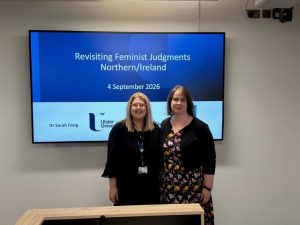
Revisiting the Northern/Irish Feminist Judgments Project
Our workshop kicked off with the deceptively simple question at the heart of feminist judgment writing: what might a judgment look like if rewritten from a feminist lens? Katie and Sarah introduced participants to the overarching premise of feminist judgment writing and invited discussion about what it means to engage with judicial decisions through a feminist perspective. A growing range of such feminist judgment projects have now been conducted by sister communities around the world, including England and Wales, Scotland, Australia, New Zealand, India, the United States and many more ongoing projects.
At its core, feminist judgment writing asks researchers to work within the constraints of the law and the facts of an existing case while reimagining how those same legal and factual conditions might have been interpreted from a feminist lens. Feminist judgments may come to the same outcome as the original judgement but by different reasoning, or may result in a different imagined outcome altogether. The objective is not to criticise a judgment retrospectively, but rather to critically engage with the case’s conceptualisation and legal reasoning itself from a feminist perspective.
Feminist judgment writing therefore may employ traditional legal methodologies of doctrinal analysis and reasoning while also inviting judgment writers to question how those same legal methodologies have been shaped by prevailing power structures and social conditions. Feminist judgment writing can offer a means to see and demonstrate that alternatives are possible and as such offers a type of ‘hybrid form of critique and law reform project’.
Feminist judgment writing projects have also often been historically approached as a collective endeavour, based on the building of a community of scholarship.
Building on and expanding an existing feminist community
Our workshop brought together a group of 22 scholars at all career stages to begin the process of developing a new collection of feminist judgments.
One of the prominent features of the workshop was the extent to which the new project was supported by those involved in the first edition, with former editors Dr Julie McCandless and Professor Aoife O’Donoghue engaging in helpful discussions with those new to feminist judgment writing. Professor O’Donoghue also shared specific reflections from the first project, demonstrating that feminist judgment projects are about much more than the production of individual rewritten judgments. They involve a range of methodological and practical questions: how cases are selected; how writers approach the original judgment and the subjects of those judgments; how the boundaries of the methodology are understood; how judgment writers work alongside commentary writers; and how collaborative decisions are made throughout the process. This insight was invaluable to everyone involved.
Continuity between the original Northern/Irish Feminist Judgment project and our new project raises exciting possibilities. First, it offers a chance to continue to build the feminist legal community on the island of Ireland. Many involved in the first project chose to re-engage with the project in various capacities, including those who were able to attend this workshop in Belfast, and others who have reached out to share advice and otherwise are contributing to the new project. We were also joined by many early career scholars who are newer to this community, and bring fresh and interesting perspectives to the project.
Second, in a substantive sense, building upon work done before offers an opportunity to consider what more there is to be done. The intervening years have been times of significant legal developments (including significant reform in relation to reproductive rights, LGBT rights, not to mention changes associated with Brexit). There has also been growing public backlash to feminist ideals, increasing discourse valorising ‘traditional’ gender roles and vilifying minorities.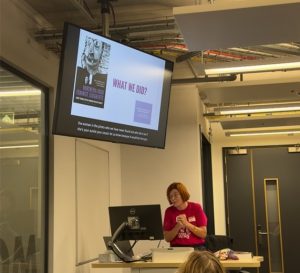
Feminist legal work therefore remains as vitally relevant as ever. Workshop participants introduced a range of judgments in need of examination, both recent and historical, in our afternoon discussions. By building upon and reflecting upon the original Northern/Irish Feminist Judgments project, we hope to look forward and explore new questions and possibilities with a new generation of scholars.
Collaboration and Reimagining
An inspiring day of conversations and collaborative scholarship, the workshop provided a valuable space to engage with critical feminist scholarship and re-begin the collective work of reimagining how legal judgments might be understood through feminist perspectives.
But the workshop was only the beginning in this project. As the project develops, we look forward to continuing these conversations and build new collaborative partnerships. Get in touch with us if you would like to be involved, and stay tuned for further workshops!
Dr Sarah Craig is a Lecturer in Law at Ulster University Belfast.
Dr Katie Nolan is an Assistant Professor in Law and Technology at University College Dublin.
Discover more from Doing Feminist Legal Work
Subscribe to get the latest posts sent to your email.