
Reflections from organising the Engaging Utopias workshop, 9-10 of March in Dublin.
Utopia can be understood as “the expression of the desire for a better way of being or of living” and, for instance, may entail a critique of the present, as well as political imagination or active struggle. As yet, literature on topics such as armed conflict, injustice, or environmental degradation remains within rigid frames of probable scenarios and possible solutions to problems, rather than extending scholarly questions toward what futures are desirable. Yet, a strand of researchers increasingly has demonstrated that re-engaging with utopianism in the Social Sciences and Law holds potential for moving beyond traps of ‘objectivity’, broadening scholarly debate; deepening critique in research on complex societal challenges; and pluralising ways of knowing societal problems and possible ‘solutions’.
Two months ago – between the 9th and 10th of March –, we hosted a workshop in Dublin on the theme ‘Engaging Utopias’, gathering researchers who work with concepts and methods of utopia and future-oriented approaches across disciplines such as Law, Political Science, International Relations, Urban Planning, and more. This workshop brought together these diverse perspectives to centre questions that as yet have remained fairly marginal as a means to challenge dominant approaches, probe potential of alternatives, and critically consider new directions for emerging research agendas of alternatives around hope, speculative ethics, or imagination.
An interdisciplinary group joined for constructive discussion around the concept of ‘utopia’ to advance scholarly engagement on the potential that ‘utopianism’ holds to deepen debates on the role of speculation, imagination, or prefiguration. Together, we assembled a body of research on utopianism that situates utopia at the state-of-the-art in critical literatures, pushing beyond essentialised understandings of the concept (e.g., utopia must be something foreclosed and finished), and presenting potential alternatives to the limitations of ‘objectivist’ or ‘realist’ traps in academic debates.
A core aim of the workshop was to create a space where we could move beyond defending utopia. Usually, working academically with utopia starts with a conversation disclaiming what utopia is not (perfect, finished, an end-state to reach), and making the case for its usefulness. In this workshop, taking utopia seriously was the starting point instead, which allowed a focus on exploring and developing notions and tensions of what utopia is or can be, and how we can methodologically study this.
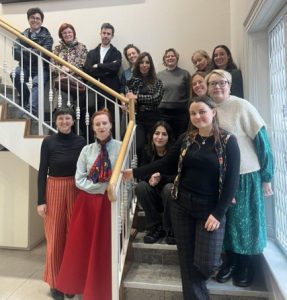
Participants of Engaging Utopia, 9-10 of March.
Tracing utopia historically, spatially, prefiguratively, and imaginatively
With this aim, the workshop included four panels:
- i) Theorising Utopia: This panel grappled with the central notion of what utopia is, attending to where the lines of utopia and non-utopia can be drawn, who bears authority on claiming utopianism, and its potential for radical and liberating politics. Presentations examined constructions of Lakedaemon, looking at how Sparta features in political imagination (Ina Sandin); how utopia functions in religious nationalism and public ethics in the US and Iran (Joel Hanisek); and what we can learn from literary utopias for theorising the International (Matthew Fluck).
- ii) Exploring spatial utopia: This panel turned the attention to the various ways in which utopia is spatially configured in urban planning (Natalie Rosales), the making of dreamhomes (Erinn De Waele), and the making of living seawalls (Sol Levii). Rather than approaching space as a fixed entity, this panel explored it as relational, opening questions about the relationship between the imagination and the materialisation of utopia.
- iii) Practising utopian Imagination: This panel presented a creative set of methods to open spaces for critical and utopian imagination, looking at a new method of temporal relief maps (Ema Gonçalves), arts-based exercises for utopian pedagogy (Suvi Salmenniemi and Pilvi Porkola), and varieties of utopia as method that help theorise how utopian imagination can be cultivated and how imagination links to societal transformation (Josie Chambers).
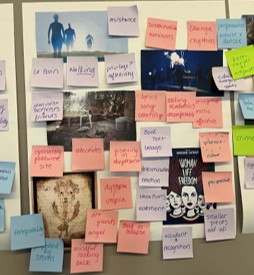 As a final session, we hosted a zine-making session, in which participants were asked to explore their notions, approaches, and methods of utopia. First, each participant presented a chosen image that in some way invoked utopia for them, and described its meaning. Together, we mapped these images and key words for each story.
Mapping from Part I of Collaborative session: Mapping Collected Images
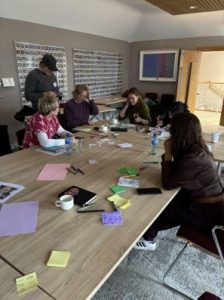
In the second part of the zine-making, we moved towards collectively crafting zines through a folding technique that results in an 8-page zine: an open-ended DIY booklet to be filled with content. Despite a relatively short time (around an hour), the zines that came out of this session carried a creative imagination of how we can approach utopia. The materials for this session were coloured foldable papers, coloured pens, and the pictures that had been collected and mapped in the first session. Working in small groups, loosely inspired by the themes of the workshop panels, participants experimented with different methods of working – some created individual zines that they combined; others built zines together, passing the zine back and forth and taking turns adding to each other’s projects so that each zine became a spontaneous joint expression. The zines that came out of the session addressed spatial aspects of utopia, politics of radical friendship, various methods, and utopian choreographies.
Zines that came out of Part II: Collaborative zine-making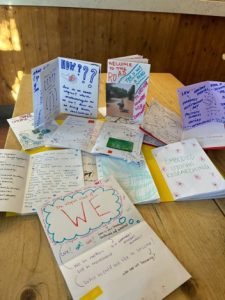
Towards crafting utopian spaces for scholarship
After organising this two-day conference, we wanted to share a few reflections on crafting spaces for utopian scholarship. One overarching aim of the workshop was to gather scholars from a wide range of academic disciplines. Despite the plurality of scholarly backgrounds, there were more overlaps than anticipated. This not only points to synergies between different fields of study, but perhaps also speaks to the potential for more interdisciplinary collaborative scholarship on utopias specifically.
Moreover, the workshop was designed to prioritise participation of early career researchers and this, too, shaped the dynamic of the workshop. We encouraged working drafts or idea papers, rather than asking participants to submit full papers or share results from their studies. Presentations varied from discussion of early ideas to works-in-progress, or expanded discussions of already-published work. As professors presented alongside PhD students and we spoke across disciplines, the group fostered a supportive and collegial atmosphere. Indeed, part of the initial idea for the workshop emerged from our own experiences of being early in our doctoral research, developing an interest in utopianism and being criticised for being ‘naive’. By creating a space where utopia need not be defended, the starting point for discussion moved beyond convincing sceptics of why this research is important, towards deeper, more interesting, and constructive dialogues about how to do research, and different approaches to these topics. We centred early career researchers, many at the forefront of their fields, who brought novel research and perspectives – legitimising their research and exposing it to critical dialogue for influencing an expanding field of scholarship.
Finally, while the aim of the workshop was to gather scholars working on utopia and future-oriented research, its purpose – as it progressed – seemed to exceed this. What seemed to be appreciated was not only having a place to talk about these matters, but also the specific way of doing so. As it seems, we not only need scholarly contexts to explore utopian scholarship, but we also need spaces where we can explore or research in an open-ended (and utopian) fashion. In other words, we need spaces where we can present work-in-progress, think together, and where there is time for meaningful conversations and connections. An overarching question discussed was therefore: what does it mean to not only conduct research on utopia, but also to take inspiration from this theorisation in the way that we do and engage with each other’s research? This workshop represents a first step towards reflecting on what it means to integrate the core aspect of our research into the way we engage with it, and it is something we will bring into future collaborations.
Conversations and collaborations during the workshop and breaks.
The workshop concluded with the aim of future collaboration through continued dialogue and an openness to the variety of forms utopian studies might take – be that in pedagogy or as a method for teaching, as the topic of what we study, or a way of conducting research.
These open-ended future endeavors will be facilitated through the email list Engaging Utopias, available here. We very much encourage other scholars currently working with, or curious about, utopia to join the email list and the conversation!
These open-ended future endeavors will be facilitated through the email list Engaging Utopias, available here. We very much encourage other scholars currently working with, or curious about, utopia to join the email list and the conversation!
The workshop was funded by the National University of Ireland Grant Scheme for Early Career Academics 2025, hosted by University College Dublin, and jointly organised by Christie Nicoson (University College Dublin) and Diana Eriksson Lagerqvist (Lund University).
Diana Eriksson Lagerqvist is a doctoral student at Lund University
Christie Nicoson is a researcher in peace and conflict studies and political science, currently working as a postdoctoral researcher at University College Dublin
Discover more from Doing Feminist Legal Work
Subscribe to get the latest posts sent to your email.