
Last week, the Social Democrats put up a post on Instagram telling their followers to ‘Dig out your Repeal the 8th Jumpers… Our work isn’t done, so we’re getting the gang back together…The Reproductive Rights (Amendment) Bill 2026. Coming Soon.’ The timing of this felt incredibly serendipitous because it just so happened that I’d dug out my own Repeal jumper a few days before this announcement. Academics for Reproductive Justice Ireland (A4RJ) had reached out to me, and I had agreed to take part in an upcoming event which was going to mark the reignition of the group, after having been dormant since the referendum on the 36th Amendment in 2018, which repealed the 8th Amendment and permitted the Oireachtas to legislate for the regulation of abortion services in the Republic.
The event was an ‘in conversation’ style panel, to showcase the work of Rimsha Syed, a Pakistani-Texan reproductive justice advocate and activist. Rimsha and I met in the exceedingly cool surroundings of the Fire Station Artists’ Studio on Buckingham Street in North-East inner-city Dublin, which is a unique residence-cum-studio-space for Irish and international visual artists. The Studio focuses on critical reflection of artistic practice, and as their website says, “a key policy of FSAS is to contribute to the debate on collaborative and socially engaged arts practice…” Academic events are almost invariably held in universities and higher education-adjacent spaces, so to be able to meet with other feminist academics in a creative space like the Fire Station Artists’ Studio felt refreshingly subversive.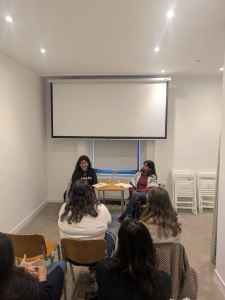
Rimsha (she/her), who has a background in investigative journalism and is also an oral historian, has spent the last many years working in various movement spaces, focusing on intersectionality across borders and liberation movements. Rimsha worked at Fund Texas Choice and Nurses for Sexual and Reproductive Health, hosting their popular podcast. Rimsha has also worked at the Asian American and Pacific Islander Labour Alliance and the Institute for Diversity and Civic Life, with her work being published in the Huffington Post, Truthout, and more of her writings can be found at her wonderful substack, the tiny pomegranate.
It was our great fortune to have Rimsha in Ireland, because what followed was an intimate and powerful conversation that touched on many different facets of her work, not least the post-Dobbs/ post-Roe legal landscape for abortion in the United States. Rimsha explained the difficult and constrained ways in which advocacy groups and abortion funds continue their work, especially in the context of assisting pregnant people wanting a termination to travel across state lines. This proved to have haunting echoes of the Irish experience, bringing up images of boats and hotel rooms, something that continues to this day, where pregnant people still have to travel for terminations in cases of fatal foetal abnormalities.
Rimsha and I were both wearing our Palestinian keffiyehs, and as two brown Muslim women who were visibly carrying our politics on our bodies, the conversation would not have been honest without addressing the impact the genocide in Gaza has had on our global understanding of who the reproductive freedom and justice movement chooses to protect and embrace. In her 2023 article, ‘We Won’t Have True Reproductive Justice Until Palestine is Free’ on Truthout, Rimsha noted the hollowness of the neoliberal institution of the NGO in the face of the catastrophe that has befallen pregnant and parenting Palestinians:
“As we look to the many reproductive health, rights, and justice organisations that have stood firm in their position on collective liberation, others have remained silent or come out with lukewarm statements that speak the language of the oppressor.”
In the same piece, Rimsha referenced how “it’s no surprise that there’s been a rise in suppression of speech of reproductive workers, advocates & communications professionals who have spoken about the genocide of Palestinians. In a recent call for a ceasefire from Reprojobs, its reported that workers in this field have been reprimanded or fired by their employers for highlighting the occupation as a reproductive justice issue.” Questioning Rimsha about this elicited a deeply personal and generous response, where Rimsha spoke, not only of the precarious conditions many activists like her are finding themselves in, but also of her own experience of facing repercussions for advocating for Palestinian liberation within the reproductive justice environment.
Rimsha has written about the need for women to take reproductive care into their own hands and how “one cannot rely on the state” in light of the state’s disinterest in (or open hostility to) people’s reproductive health; in a co-authored piece on herbal abortion ancestry in Iran and Pakistan, Rimsha highlighted the need for community-led reproductive healthcare. Being Pakistani myself, I felt the resonance in her words, and could not let the evening end without exploring this with her. Access to reproductive healthcare, in all its forms, has always existed and been provided by the Community alongside ‘official’ healthcare providers in Pakistan. Community-led initiatives like the Mama Baby Fund and Safe Delivery Safe Mother have grown tremendously in both geographical reach and funder-backed legitimacy in Pakistan because they can do what the State can’t (or won’t). In a country where access to safe maternity services varies wildly based on economic and geographical privilege, it is the Community (and its women) that fill those gaps. The conversation that followed allowed us to speak frankly and openly about the realities of being racialised immigrants and children of immigrants, about the urgent need to place those most marginalised at the centre of the movement for abortion freedom and reproductive justice, and how we ourselves have found liminality at these forced margins.
Prior to this evening, I don’t think I had had a chance to really process my experience of giving birth in Ireland, either of engaging with the healthcare system as a racialised woman, knowing what I knew about how we are dying more than anyone else whilst giving birth, or of what it felt like to do so just as the most recent iteration of the genocide in Gaza started. I had never really processed the intense feeling of rage and sadness at the thought of how crying white women held up photos of Savita at Dublin Castle as the results of the referendum were being announced, all the while leaving women like me and Savita behind in the legislation that followed. But this intimate gathering of generous and kind feminists, who gave Rimsha and me the space to untangle our thoughts and feelings, and who discussed the localised nature of the feminist ethic of care that community brings with it, was the perfect audience to have this conversation with and in front of.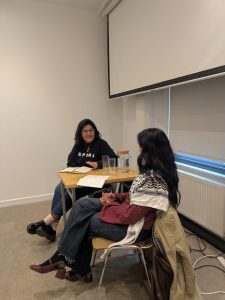
Since that day, Rimsha and I have stayed in touch. She sent me news that the 5th U.S. Circuit Court of Appeals, has on Friday (1st May 2026) blocked the abortion medication mifepristone from being sent in the post, nationwide. Meanwhile, at home for me in Ireland in the south, the Reproductive Rights (Amendment) Bill 2026 has passed the first stage in the Dáil and is set to be debated in the House on 13th May 2026.
We ended the event with our thoughts on what gives us hope. Rimsha spoke of broader solidarities, intersectional and cross-boundaried, and I spoke of my mixed-race, Irish, Muslim daughter. Both hold promise of a better future.
Dr Sahar Ahmed is an Assistant Lecturer in Law at the School of Social Sciences, Law and Education at TU Dublin.
Discover more from Doing Feminist Legal Work
Subscribe to get the latest posts sent to your email.